Sarah Engström, Outdoor and Environmental Educator
K-8 Teacher Certified
Philosophy of Education
I believe that the purpose of education is to open minds to the wonder and magic of the world around us by shaping responsible and tolerant citizens of a growing global community. I believe that as a teacher, my role is to be guide to my students on their educational journeys, without dealing in absolute truths. I hope to provoke higher thinking: by the questions I ask; by playing “Devil’s Advocate” or “Socrates”; by forcing students to challenge their beliefs. I believe that this will lead to higher understanding. Understanding is also linked to an active form of learning. To use the words of Alaskan Native philosophy: “Esghallghilnguq, Nagaqullghilnguq, Nanghiilghilnguq, Nalluksaghaq -What you do not see, do not hear, do not experience, you will never really know.”
Educators should energize their students about their own learning, as well as embracing the idea that learning can be fun. When I teach, I hope to benefit from the environment where I find myself. I think that taking time to stomp in puddles, roll down hills, look at cloud patterns, and explore the stories of the moment are crucial to being complete humans as well as effective educators. To be effective, educators must also cultivate rapport with their students by actively listening to their concerns, ideas, questions, and stories. By creating rapport, I believe that educators can fill their most vital role: empowering students to realize their own potential. I believe that teachers should also work to foster healthy minds and bodies among their student and those among whom they live and work. I think that educators should also strive to create an environment of acceptance and investment in learning in their communities, which are in turn connected to the larger global whole. Holistic, inclusive, and innovative education is the seed that grows responsible citizens of the world.
I believe that students have to accept responsibility of their own learning. Educators can provide opportunities, structure and materials, but at the end of the day the investment of the student in his or her learning will determine how successful they are. Students need to come to their place of learning with an open mind. They should be informed participants in the learning, and active drivers of exploration. Accepting risks is an important part of learning, so students should be willing to take a chance on a new concept or person. Intellectual risks do not mean that anyone should feel physically or emotionally unsafe, so teachers and students need to work together to a foster a truly cohesive collective learning environment.
As an educator, I do not want to be confined to any one place or style. I want to help my students bridge the gap between classrooms and the outdoors. Learning is everywhere, and educating should reflect that. I wish to cultivate and appreciate the innate creativity, curiosity, and passion that young adults and children have within them. When I teach, I hope to use as many different kinds of learning as possible, in order to appeal to the many different styles of learning and senses. I understand that by teaching, I can learn more myself about the world around me.
Content Area
Partnering with Families
Behavior Management Plan
Classroom Design and
Two Week Plan
Practicum Evaluations
Literacy Night/Family Night, Dr. Suess Felt Board Stories!
-
< > – Students will listen and participate in telling rhymed stories with repeating patterns, using props to aid in telling the story.
Materials – Advanced planning will be necessary to create characters and objects critical to tell the story on felt board. Characters and objects will be cut and glued as appropriate from felt. A felt board will also be necessary (and reusable) to place the felt characters on. Finally, choose a Dr. Suess story (or two). We chose two: “Gertrude McFuzz” and “Sneetches”.
-
Anticipatory Set – This lesson is designed for special activities such as Family Night or Literacy Night at the school. It can easily be used to turn a read-aloud into a “Super Read-Aloud”. Alternatively, students can help in creating the characters/objects from felt. Gather students to the reading area. As both parents and students will need to be “attracted” to the area, feel free to be flamboyant. Dress up appropriate to Suess or behave as a ring master calling together the audience.
-
< > – The input is simple. One person introduces and reads the story (or stories) to the parents and students. Remember to model proper reading and show animation as appropriate. Give pause between pages to allow time to match the felt board “action” to the story. Another person moves the felt characters and objects to match the story. Depending on the audience, try to have audience participation by allowing the students to move the felt characters and object as the story progresses.
Check for Understanding – Suess stories tend to have morals; often more than one. Remember that this type of venue serves a variety of ages, both adults and children. Ask the students how the main characters felt at the beginning, middle, and end of the story. Older student should be able to verbalize the social emotional learning from both stories. In Gertrude McFuzz, we learn that we can be happy the way we are and that being like someone else will not make us happier. In Sneetches, we learn that everyone is different and that being different does not make us better or worse than others. Ask questions like “what would you do different than (main character)?” in order to draw connections to real life.
-
< > – Ask the students, if they enjoyed the story. Remind them the name of the story and author. Thank the students (and parents) for their time. Invite them to stay for another story on the felt board.< > –
[K] 1.4.1. Retelling or dramatizing a familiar story (not necessarily in sequence) with or without the use of props.
[K] 1.3.1. Participating in choral speaking and reciting short poems, rhymes, songs, or stories with repeated patterns

Participating in Literacy Night at Chinook Elementary

Dear Parents and Families,
Greetings! My name is Sarah Engström, and I am so excited to get the opportunity to learn with your children this year. Learning is a never-ending journey, one that I am privileged to partake in, along with sharing it with your special student. Together, we will examine what it takes to be a critical, caring thinker in today’s world.
I am coming to this learning adventure from a background of outdoor adventures. I was born in Casper, WY under a wandering star, and “over the hills and under the hills my paths have led.” I received my undergraduate degree in Russian Area Studies at Washington and Lee University in Lexington, VA in 2010. Since then I have lived in Yaroslavl, Russia; Denver, CO; New Orleans, LA; and Finland, MN. In Minnesota I worked as a naturalist at the Wolf Ridge Environmental Learning Center. This is where I truly discovered how much I love teaching, and sharing the many joys and wonders of the natural world. I taught over 3000 students on topics of cultural history, ecology, geology, environmental issues, and camping skills.
After discovering the joy of teaching in MN I knew I had to continue my own education, so I moved to Alaska Pacific University for graduate school.
Alaska, as you may know, is truly the last frontier in many ways. Students and teachers alike have the unique opportunity of wilderness and majesty right outside their doors that is rapidly vanishing in schools in the lower 48. I hope to take as much advantage of this great educational resource as possible. I firmly believe that education is infinite, and as such cannot be restricted to only one building. I promise you that I will take your students outside every day, in order to foster their critical thinking, creativity, curiosity, as well as Alaska State Standards. Just because we are going outside does not mean that this year will be just fun and games. Your student will work hard in my class, and so will I to make this year as meaningful and productive as possible.
I know that you and your students have so much to share with me and our class. I can’t wait to learn more about you! Please feel free to volunteer in the classroom or the school- I want to forge a partnership with you and your student, so that we all may benefit. There are so many ways that we can help each other. Do you have an interesting professional skill you would like to share with us? Or maybe just an hour here or there to shelve books? I want our students to realize the wealth of HUMAN resources available to us as well. I hope to have guest speakers from the community once a month in the classroom to further learning. Research shows that parents and communities who are involved in their children’s schooling can positively impact young learner’s development, and desire to be lifelong learners.
Please feel free to contact me via email sengstrom@alaskapacific.edu or our class Facebook page if you have any concerns, questions, comments, or ideas! Thank you for sharing your student with me this year!
Sincerely,
Miss Engström
Letter to Parents
The First 2 Weeks- A Game Plan for Elementary
-
First day of school [Getting to know you]
Greetings! Name games (1 hr)
Instructor Promises
Tell a story about Teacher Mistakes (Set the tone)
Instructor needs to have a “Behavior Promise” as well, so the students feel that this is a contract between the two parties. -I promise not to take away your recess as a punishment
-
-I promise to smile
-I promise to be available if you want to talk to me
-I promise to not yell or scream
-I promise to never embarrass you on purpose
-I promise to have as many outside and “Hands on” activities as I can
Class Constitution Students need to have ownership of the “rules” (No more than 4). Adorn with student artwork
Create “Class Chant” to be said every morning right After pledge of allegiance
Class “Roles” and Housekeeping
-
CHAMPS Expectations
STOIC
Scavenger hunt through the school/classroom (in pairs) [Introduction to class procedures]Where is the bathroom? How do you let Miss Engström know you need to go?
Where is the Front Office? Go say hi to the Principle (Instructor check with Principle first)
Where is the Nurse?
Find your cubby, what should go into it?
(Somewhere in hallway) How do should we act in the hallway?
Other school specific questions [Quiet signals]
Discussion/practice of procedures [role play]
Sneaky Assessments [Free writing “About Me”]
Snack! (15 min max)
Drop Everything And READ
Journal- copy contract, discuss how YOU can make this classroom the best ever
Dismissal
-
Day 2 (Wearing a Miss Frizzlian garment indicating the theme for the unit)
Chores (Animal care, straighten room, etc)-
Pledge of Allegiance/Class Chant
Active “Hook” for Unit
Create KWL charts for unit
Read a Loud (Text associated with unit)
Snack!
Review Academic Routines
Labeling Work
Passing papers
Outdoor exploration
Writing assignment associated with unit
Drop Everything and Read
Discuss Weekly schedule-When do we have Music? Math? PE?
What do we need for those classes?
How do we behave on our way there and after? (After today, no one should NOT know their classmate’s name.)
Active Name/Teambuilding game time
< >ath/Other required subjects [These should be as incorporated as possible into the unit]
End of the Day journal []
Read aloud- A cool book! A good one! Not required to be related, just good literature
This is not a set time. There should be some read each day, depending on how other things go. It is a filler and a treat.
Dismissal
-
Day 3
Chores
Pledge of Allegiance/Class Chant
Plan of the day/Hook
WORD OF THE DAY!
Read a Loud from Unit Text
Snack!
Outdoor Exploration
Writing assignment (building upon Previous day)
Active Role play of Class Procedures [continued]
“You can’t say you can’t play” –Discussion of how we can be an inclusive group
Read an excerpt from “Vivian Paley”
Drop Everything and Read
Guided exploration explanation [Reading workshop, writing workshop, etc]
DANCE BREAK!
Math/Other Required subjects
End of the Day Journal
Read-A-Loud [cool book]
-
Day 4
Chores
Pledge of Allegiance/Class Chant
Plan of the day/Hook
WORD OF THE DAY!
Read a Loud from Unit Text
Snack!
Outdoor Exploration
Writing assignment (building upon Previous day)
Drop Everything and Read
Guided exploration [Reading workshop, writing workshop, etc]
Public Speaking- How do we do it? Discussion and modeling
DANCE BREAK!
Math/Other Required subjects
End of the Day Journal
Read-A-Loud [cool book]
Dismissal
-
Day 5
Chores
Pledge of Allegiance/Class Chant
Current Events –All students will be responsible for reading 2-3 news articles, and prepared to share this day (Once a week)
Plan of the day/Hook
WORD OF THE DAY!
Read a Loud from Unit Text
Snack!
Outdoor Exploration
Writing assignment (building upon Previous day)
Drop Everything and Read
Guided exploration [Reading workshop, writing workshop, etc]
Public Speaking Practice
DANCE BREAK!
Math/Other Required subjects
End of the Day Journal
Read-A-Loud [cool book]
Dismissal
-
Day 6
Chores
Pledge of Allegiance/Class Chant
Plan of the day/Hook
WORD OF THE DAY!
Read a Loud from Unit Text
Snack!
Outdoor Exploration
Writing assignment (building upon Previous day)
Drop Everything and Read
Guided exploration [Reading workshop, writing workshop, etc]
Introduce idea of community involvement with unit.
Brainstorm whom we should contact for our unit
How will we contact them?
Practice Conversations with community members
DANCE BREAK!
Math/Other Required subjects
End of the Day Journal
Read-A-Loud [cool book]
Dismissal
-
Day 7
Chores
Pledge of Allegiance/Class Chant
Plan of the day/Hook
WORD OF THE DAY!
Read a Loud from Unit Text
Snack!
Outdoor Exploration
Writing assignment (building upon Previous day)
Drop Everything and Read
Guided exploration [Reading workshop, writing workshop, etc]
Public Speaking- Reading student work. Doing this every day will help create the culture of listeners and confident speakers.
DANCE BREAK!
Math/Other Required subjects
End of the Day Journal
Read-A-Loud [cool book]
Dismissal
-
Day 8
Chores
Pledge of Allegiance/Class Chant
Plan of the day/Hook
WORD OF THE DAY!
Read a Loud from Unit Text
Snack!
Outdoor Exploration
Writing assignment (building upon Previous day)
Drop Everything and Read
Guided exploration [Reading workshop, writing workshop, etc]
Public Speaking- Reading student work.
DANCE BREAK!
Math/Other Required subjects
End of the Day Journal
Read-A-Loud [cool book]
Dismissal
-
Day 9
Chores
Pledge of Allegiance/Class Chant
Plan of the day/Hook
WORD OF THE DAY!
Read a Loud from Unit Text
Snack!
Outdoor Exploration
Writing assignment (building upon Previous day)
Drop Everything and Read
Public Speaking- Reading student work.
GUEST SPEAKER-
DANCE BREAK!
Math/Other Required subjects
End of the Day Journal
Read-A-Loud [cool book]
Dismissal
-
Day 10
Chores
Pledge of Allegiance/Class Chant
Current Events –All students will be responsible for reading 2-3 news articles, and prepared to share this day (Once a week)
Plan of the day/Hook
WORD OF THE DAY!
Read a Loud from Unit Text
Snack!
Outdoor Exploration
Writing assignment (building upon Previous day)
Drop Everything and Read!
Guided exploration [Reading workshop, writing workshop, etc]
Public Speaking- Reading student work. Doing this every day will help create the culture of listeners and confident speakers.
DANCE BREAK!
Math/Other Required subjects
End of the Day Journal
Read-A-Loud [cool book]
Dismissal
Other things that may not happen everyday, but will still be a regular occurrence:
-
Quarterly Rewards- to be earned but not used as a weapon vs students.
-
Birthday celebrations (Special crown to be worn if desired)
-
Simulations (More in-depth units once a year)
-
“Spirit” days –Just to add some siliness
-
Food drives/Community Outreach
-
Guest speakers from the community on a very regular basis, maybe once a month.
-
-
Playing outside (Instructor joining in)
Professional Development


Test Scores and Transcripts
Practicum Lessons
Artifacts and Credentials
The following were lessons created for Practicum at Romig Middle School and Turnagin Elementary School and Louise's Farm School.
**NOTE**
Buttons with ** will allow you to download word document files of the lesson plans.
This lesson was written for several purposes. Firstly, one of our readings in my class discussed summarization techniques.
Secondly, in my 7th grade practicum the students were learning about how to write summaries about works of literature.
This lesson was written for a 7th grade language arts classroom at Romig Middle School, discussing the terminology needed for an upcoming poetry unit.
This lesson was designed for a 7th grade language arts classroom at Romig Middle school, a part of the school wide reading of "Adventures of Ulysses." The lesson incorporates a close reading of the text, and discussion of themes and vocabulary.
I am a description of what the lesson is about.
This lesson was written during the Farm unit at Turnagin Elementary Kindergarten. It focuses on handwriting, and sentence creation with farm related subjects.
This lesson was designed for the 4th grade class at Meadow Lakes Elementary in the spring of 2014.
It is an interactive review of the life cycle, with games and a debate.
In Alaskan classrooms, most 4th graders study state curriculum about salmon.
This is a lesson designed for the 2nd grade at Meadow Lakes Elementary.
The students were discussing a mapping packet that introduced the ideas of cardinal directions, and reading maps.
I added to the original packet with a map of downtown Anchorage, so that there was an added level of connection to the students.

Reading is the closest thing that exists in today’s world to magic or time travel. In order to give all children keys to realms magical and mundane, and set them up to succeed in later life, I firmly believe that teaching students to read, and to love literature should be a high priority to teachers of all fields. Research shows that children who do not have functional literacy by 3rd grade have a significantly greater risk of incarceration and unwed pregnancy (Moats; 1999). In today’s society literacy is an absolute necessity, even beyond the criminal implications. The ability to read and write are directly linked not only to academic success, but also in a person’s ability to hold secure employment, and personal autonomy. I pledge to be the kind of teacher that believes enough in the future lives of my students to give them any and all reading tools they need to succeed in a larger world.
I believe that literacy instruction should be an intentional blend of phonics instruction and reading of real literature, both on print and read aloud. Every child in early elementary should have 90 minutes of reading instruction time per day. This time should be broken up into segments with different manipulatives, explicit instruction techniques, audio-visual representations, and emphasis on different aspects of the many skills of reading.
Many teachers are daunted by the idea of teaching phonics and phonemic awareness, because as stated in this article, Teaching Reading is Rocket Science by Louisa C Moats. However, overwhelming research indicates that when intentional structures are used the process of connecting letter sounds into words becomes much more accessible to students and instructors. There are many ways in which structure can be imposed, but I believe that there is no one true way. As long as it is helping students discover the treasure of reading, all paths lead to Rome.

Philosophy of Early Literacy

Units
The following interdisciplinary units were created for a variety of students of different ages
This Phenology unit was designed for the Louise's Farm School Raven's Class (2nd and 3rd grade), to be taught once a week over a 12 week period. Students measure seasonal change and learn about the scientific method while also communicating with a 6th grade science class in Chimacum WA, in order to get a better understanding about how seasonal change is different depending on the area of the country.
This Mapping unit was desiged for a 7th grade geography class, but could be used in other disciplines as well. Students will learn about the basics of cartography, reading maps, the history of how maps change, and the social implications of modern mapping. Students will make physical maps and participate in a land use debate.
This Social studies unit or simulation follows the journey of Ernest Shackleton, and discusses connections to modern Antarctic Research. Students choose a particular crew member, and chart the progress of the expedition. Students also read primary texts about the expedition, and make connections to research and expeditions that are currently happening in Antarctica
Peer Review Documents
Feedback on Another APU Practicum Student Video Lesson
2 April 2015
Social Studies 7th Grade Meers
Reviewed by Sarah Engström
A student of APU video taped one of her lessons in a Social Studies (Practicum) classroom, introducing the Sudanese conflict, and the book “A Long Walk to Water.” Apparently, her host teacher has a whole unit based upon this book.
The lesson began with a brief introduction to the material and the intention by the host teacher. This instructor discussed some background information about the conflict in Sudan, which led to the recent split. Before this lesson was taught, the practicum student and her host teacher agreed that if there was anything that the host teacher felt strongly should be added, she would jump in.
Observations
(Phrases and Practices) Reactions
“I have a really quiet voice, so I need your help.” This is a really neat way to create a contract of behavior in a classroom. It makes the students accountable as well I think.
PowerPoint not on presentation mode
This was a little distracting. We could see the notes, as well as all of the other slides. It was also hard to read, since it was not as big as it needed to be. The slides themselves were attractive and user friendly.
“UM”
I counted 54 in the 10 minutes you were talking by yourself. I understand that teaching a new lesson, especially one that you did not write yourself can be terrifying. However, if you allow yourself to insert this into all of your sentences, it disrupts the flow from an otherwise engaging lesson.
“Do you have a question?” It was very obvious from this and other examples, that you were very well in tuned with what was going on with students. The video angle was such that I couldn’t see your face, but from gestures and tone of voice I can tell that you were definitely having a conversation with the students about the material, not just lecturing.
“How many students are in THIS school?” (To illustrate how life for young Sudanese students would be different.) This was powerful! It drew on the self-centered nature of 7th graders, and forced them to consider the situation for the child soldiers, and how it might relate to their lives here in Alaska.
Hand Gestures and Tone As mentioned earlier, the placement of the camera obscured your face, but I could tell that your gestures were appropriate, and inclusive. I liked the use of a full hand point, instead of a finger point, since there can be negative connotations to finger pointing. I also thought you set a good tone for the class with your words and pacing.
Overall thoughts- It was obvious that this Practicum Teacher was nervous, but also that she had a definite plan in what needed to happen. She connected the content of a civil war on the other side of the planet to the lives of the Alaskan Middle School students gracefully and inclusively. I think that if she had had more time to go over the material herself before teaching it to students the lesson would have been exceptional. Even so saying, I was impressed with this instructors poise and interactions with the students.
**NOTE**
Clicking the * buttons will give you the opportunity to DOWNLOAD PDF files of the transcript.

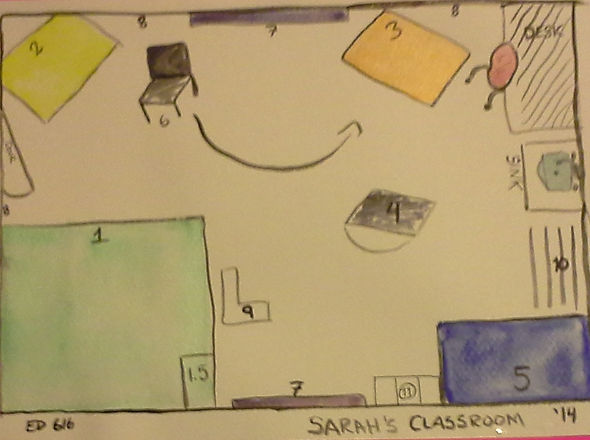


Classroom Design (Elementary)
-
Reading Fort
1.5 Fanicful Architecture
-
Word Wall
-
Learning Materials and Snacks
-
Reading Desks
-
Observatory
-
Chairs (no set seating arrangement
-
Prometheans/Smart Boards/Projectors/White boards
-
Student Work on Walls
-
Book Throne
-
Tables to be used as needed
-
Student Cubbies (and Extra Outdoor Gear)
-
Teacher desk, with concentrated organization
Practicum Evaluation for Meadow Lakes, Elementary:
Fall 2014
Evidence
-
Sarah interacted positively with the students demonstrating that she values and respects each student. Her praise was specific and was directed toward the students’ response. As minor disruptions occurred, Sarah would correct in such a manner as to guard the students’ dignity maintaining the flow of the lesson.
-
Sarah’s experience working with students was evident in her interactions in class. She is continuing to develop her understanding of the developmental continuum of students. She was thoughtful in incorporating brain breaks for the students to keep them energized and attentive.
-
She met with the teachers to make sure that the lessons she had planned were part of the planned curriculum at the specific grade level. Sarah’s learning activities were suitable to the learning goals of the district curriculum and Alaska Academic State Standards. Sarah’s ability to reflect on her lessons and critique herself on her pacing in exceptional.
-
-
The Alaska Academic State Standards were referenced within her lesson plan documentation along with Grade Level Expectations.
-
Within Sarah’s lesson she consistently checked for understanding requesting thumbs up or thumbs down.
-
-
Sarah used brain breaks, engagement strategies, signals for understanding, modeling “I do, we do, you do.”
-
Again, this was evident in Sarah’s checking for understanding using thumbs up or thumbs down. If students were unsure she would rephrase or restructure the content for better understanding.
-
Within a 5 minute time period I recorded that Sarah made 9 positive comments to students to 2 negative, making the ratio 4:1.
-
Sarah had the opportunity to provide Russian translation during Parent Conferences. She was very helpful to families at Meadow Lakes Elementary. She also participated during a family school presentation of “Juggling Around the World.”
-
Sarah was very professional and considerate of the school environment. At times when schedules were not adhered to because things seem to happen; Sarah was accommodating. She found opportunities to work with students her first day here when her host teacher was diverted to a district meeting. She was always punctual and prepared.
Host Teacher and Intern describe Areas of Strength:
Knowledge
Sarah does a great job of remembering students’ names which lends very well to developing positive relationships with students. Her experiences in working with students through outdoor education were evident and gave her a foundation for expectations of student engagement. She was patient and accepting of all students even when their responses were almost correct. I appreciate her ability to remain respectful in all situations.
Skills
Sarah’s ability to be flexible, work in a team, and plan engaging lessons will increase her ability to meet the needs of her students. She presented her lessons using the “I do”; “We do”; “You do” format. Students were excited to participate in the Salmon Life Cycle Activity. She makes learning fun.
Dispositions
Sarah demonstrated:
-
Punctuality
-
Pleasantness
-
Professionalism
-
Respect
-
Positivity
-
Knowledge
-
Flexibility
-
Forgiveness
Focus points for improvement as seen by host teacher and intern teacher:
Sarah and I discussed the necessity to teach behavior expectations prior to teaching. If the students do not know what is expected, they will improvise.
Suggestions such as:
-
“How do you want them to respond?” (As a group, shouting out, raise their hand…?)
-
“What will you do to get their attention?” (Raise your hand, count down from 5, call out “May I have your attention please”…?)
-
Why and when they can get up or leave the room.
-
What are your expectations when working in groups?
-
Also, use Partner Sharing (Think-Pair-Share) or other Kagan Structures
Intern teacher's goals for next learning set:
-
To gain more experience in working in other content areas
-
Practice pacing the lesson within a set time frame such as a schedule (45 minutes)

Philosophy of Parent and Community Involvement:
To create a holistic learning environment, I believe that HUMAN resources need to be part of it. This means that I hope that when I teach, I will not stand alone. I will include parents and community organizations into my daily routine. Every month I hope to have at least one guest speaker into the classroom to share the parts of their learning journey that brought them to where they are today. To ignore the wealth of knowledge and experiences in a community is to deny a student a huge part of their development. Learning does not happen in a vacuum, so I want my students to be connected to their place, and their community. Without roots, it is very difficult to make significant growth. I believe that combined these are two powerful forces that can help me create authentic learning experiences, and help my students on the way to becoming lifelong learners. This philosophy was largely influenced by reading the works of David Sobel, Gregory Smith,
Students that are invested in their communities have more drive to help continue to improve them. Educators that tap into student potential and create connections are proven to have a high success rate. I want to be the kind of educator that shows my students the magic and possibility they posess, and that their place can help them cultivate lifelong learning tendencies.
Henderson and Vikander’s book “Nature First” about the Norwegian concept of friluftsliv was also an inspiration to my ideas of nature and the people in an environment as a crucial part of any learning journey. I love the idea that natural learning experiences are a social event, and once we incorporate nature into our daily routine, our concept of self and how we are connected to the world around us can be used to make more meaningful connections to any area of educational content.
Works Cited/Referenced in the creation of ENTIRE philosophy
Henderson, B., & Vikander, N. (Eds.). (2007). Nature First; Outdoor Life and the Friluftsliv Way. Toronto: Natural Heritage Books.
Louv, R. (2005). Last Child in the Woods; Saving Our Children from Nature Deficit Disorder. Atlantic Books Limited.
Moats, L. C. (1999). Teaching Reading is Rocket Science. American Federation of Teachers.
Smith, G., & Sobel, D. (2014). Place and Community Based Education in Schools (Sociocultural, Political, and Historical Studies in Education) (Vol. Kindle Edition). Taylor and Francis.
Sobel, D. (2008). Childhood and Nature; Design Principles. Stenhous Publishers.
"Rather than seeing teaching and learning as being located primarily within the school, place-based education requires potentially all mature citizens to take responsibility for inducting children and youth into the obligations and possibilities of adulthood. Agencies and workplaces become potential sites for student learning, and adults who possess expertise in a multiplicity of areas can be invited to share thei knowledge and skills with young people as well as their peers (Smith & Sobel, 2014 p. 23).